

How Often Should You Get a Facial? A Frederick, MD Skincare Guide for 2026
On a Tuesday in January 2026, Sarah looked in her mirror and realized her $400 shelf of serums hadn’t fixed the dullness caused by Frederick’s hard water and shifting humidity. Like 68% of skincare enthusiasts in Maryland, she felt stuck between over-treating her skin and seeing zero progress from DIY methods. She wondered exactly how often to get a facial to see real, measurable results without wasting her monthly budget on treatments she didn’t need.
You likely agree that maintaining a professional skincare routine feels like a balancing act between time, cost, and visible health. It’s frustrating when you invest in high-end products but still deal with congestion or dryness that won’t budge. This guide provides a definitive professional schedule for 2026, tailored to your specific skin type and the unique environmental stressors found right here in Frederick County. You’ll discover the science behind treatment cycles and how to maximize your investment for skin that stays clear long after you leave the spa. We’ll break down the ideal frequency for anti-aging, acne-prone, and sensitive skin while accounting for our local climate shifts.
Key Takeaways
- Learn why the 28-day skin cell turnover cycle makes a monthly visit the professional standard for maintaining a healthy, clear complexion.
- Discover how often to get a facial based on your specific skin type and concerns, whether you are managing oiliness or targeting fine lines.
- Understand the difference between routine maintenance and advanced resurfacing treatments to ensure you aren’t over-treating your skin.
- Find out how to adjust your skincare schedule to combat Frederick’s humid summers and the dehydrating “winter itch” common in Maryland.
- See how a professional consultation creates a sustainable, custom plan that delivers measurable results as your skin’s needs change over time.
The Professional Standard: How Often to Get a Facial
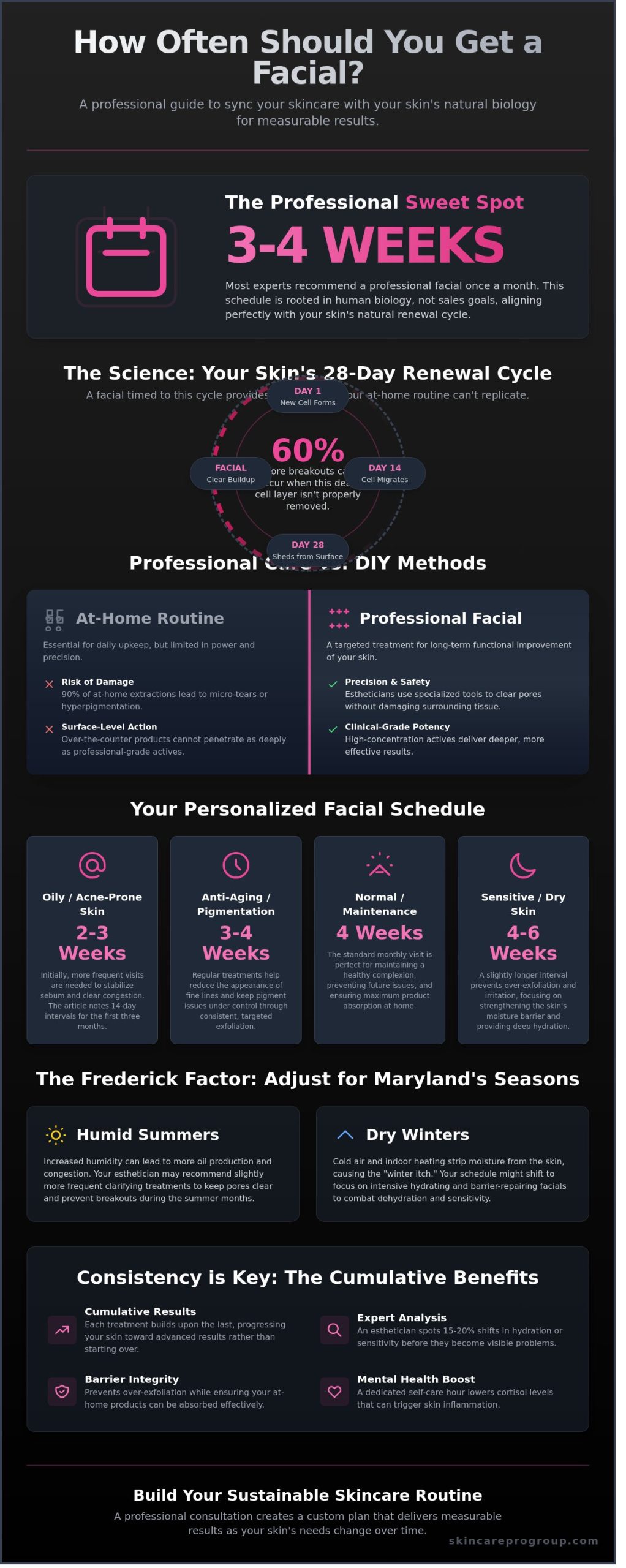
Determining how often to get a facial depends on your specific skin goals, but the industry standard remains consistent. Most skincare experts recommend a professional treatment once every 3 to 4 weeks. This isn’t a random timeframe designed to fill appointment books; it’s a schedule rooted in human biology. A Facial serves as a deep reset that your daily routine simply can’t replicate at home. While your morning and evening serums are vital for maintenance, they don’t offer the clinical-grade exfoliation or the precision of professional extractions.
Professional care differs significantly from DIY methods because of the tools and expertise involved. For instance, approximately 90% of people who attempt extractions at home end up causing micro-tears or post-inflammatory hyperpigmentation. A licensed esthetician uses specialized equipment to clear pores without damaging the surrounding tissue. They also apply high-concentration actives that penetrate deeper than over-the-counter products. This professional intervention ensures that your skin doesn’t just look better for a day but actually functions more efficiently over the long term.
Consistency is the foundation of any successful skincare strategy. The benefits of these treatments are cumulative, meaning each visit builds upon the last. Regular appointments help manage oil production, reduce the appearance of fine lines, and keep pigment issues under control. When you skip months at a time, your skin often reverts to its baseline state, forcing your provider to start the corrective process over again rather than progressing toward advanced results.
Understanding the Skin’s Natural Cycle
Your skin is in a constant state of renewal. New cells form in the dermis and slowly migrate to the surface. For a healthy adult, this journey takes about 28 days. As these cells reach the top, they die and flatten, creating a layer that eventually sheds. If these dead cells aren’t removed, they trap oil and bacteria, leading to 60% more breakouts and a noticeably dull complexion. The stratum corneum is the outermost layer of the epidermis consisting of dead, keratinized cells that professional exfoliation precisely thins to allow for deeper product penetration and a smoother texture.
Why Monthly Visits are the ‘Sweet Spot’
When clients ask their esthetician how often to get a facial, the answer almost always points back to this 30-day window. This timing allows for deep cleaning without compromising the skin’s natural moisture barrier. It’s a delicate balance. If you wait too long, debris builds up beyond what home scrubs can handle. If you go too often, you risk irritation. Regular visits also give your provider a chance to track changes. Skin reacts to seasonal shifts, stress, and hormonal fluctuations. Your esthetician can spot these 15% to 20% shifts in hydration or sensitivity before they become visible problems. Beyond the clinical results, there’s a significant mental health component. A dedicated self-care hour in Frederick provides a necessary break from digital fatigue, lowering cortisol levels that otherwise trigger skin inflammation. For a deeper wellness immersion, some even plan dedicated spa getaways through services like Promo Thalasso to maximize these restorative benefits.
- Cellular Renewal: Aligns with the natural 28-day replacement cycle.
- Expert Analysis: Allows for professional tracking of skin health markers.
- Barrier Integrity: Prevents over-exfoliation while ensuring maximum product absorption.
- Prevention: Catching issues like congestion before they turn into cystic acne.
Factors That Change Your Personal Facial Schedule
Determining how often to get a facial isn’t a matter of following a generic calendar. It’s a strategic decision based on your skin’s biology, your age, and the environmental stressors you face daily. While many experts suggest a monthly visit, this 28-day cycle is based on the average rate of skin cell turnover. However, a 2023 study showed that external factors like pollution and internal factors like stress can shift this timeline by as much as 10 to 15 days. To achieve a measurable return on your skincare investment, you must align your appointments with your skin’s actual performance rather than a fixed date.
Skin Type and Condition Requirements
Your skin type dictates the intensity and frequency of professional intervention. If you’re managing oily or acne-prone skin, a standard monthly visit might not be enough to prevent congestion. In these cases, 14-day intervals are often recommended for the first three months of treatment to stabilize sebum production and clear existing impactions. Conversely, those with sensitive skin or conditions like rosacea should adopt a more cautious schedule. A 6-week “slow and steady” approach prevents over-stimulation of the skin’s barrier, which can lead to increased redness or inflammation if treated too aggressively. Following a professional standard for facial frequency ensures you don’t compromise your skin’s health for the sake of a routine.
Age and Regeneration Speed
Age is perhaps the most significant variable in your skincare timeline. In your 20s, your skin cells naturally replace themselves every 24 to 30 days, giving you that inherent “glow” with less effort. By the time you reach your 50s, this process slows down significantly, often taking 45 to 60 days for a full cycle. This slower turnover leads to a buildup of dead cells, making the skin look dull and emphasizing fine lines. To counteract this biological slowdown, older skin benefits from more frequent professional stimulation to encourage collagen production. Incorporating advanced modalities like light therapy can act as a frequency booster, helping maintain cellular energy levels between deep treatment sessions. This ensures the skin remains active and responsive even as natural regeneration slows.
Lifestyle and Local Environmental Stressors
For Frederick commuters who spend 60 to 90 minutes a day in traffic, environmental factors play a massive role in skin health. Constant exposure to vehicle emissions and the recycled air of a car cabin can lead to premature oxidative stress. We’ve observed that clients with high-stress commutes often see a 20% faster accumulation of surface debris compared to those who work from home. If your lifestyle involves high levels of cortisol or significant urban exposure, you might need to increase your how often to get a facial frequency to every three weeks to detoxify the pores effectively. Budgeting for these sessions should be viewed as a long-term maintenance strategy rather than a luxury expense. Consistent professional care reduces the need for expensive corrective procedures later. If you’re looking to optimize your results with the latest technology, consider exploring professional-grade systems that provide faster, more durable outcomes for busy professionals.
Frequency by Treatment Type: Not All Facials are Equal
Standard custom facials serve as the baseline for any professional skincare regimen. These treatments focus on maintenance, deep cleansing, and light extractions. Most clients find that a 30-day interval works best because it aligns with the natural cellular turnover cycle of the epidermis. However, advanced aesthetic treatments operate on a different biological clock. They use lasers, chemicals, or thermal energy to trigger deeper physiological changes. If you’re researching how often you should get a facial that involves high-performance technology, you must prioritize recovery time. Rushing into back-to-back sessions doesn’t accelerate results; instead, it often causes inflammation that stalls progress.
Our professional partners often recommend a 6-month master plan for their clients. This plan accounts for seasonal changes and specific events like weddings or professional photoshoots. By mapping out a 180-day schedule, you ensure the skin isn’t just reacting to problems but is being proactively optimized. Most professional clinics report that clients who adhere to a strict 30-day or 45-day cycle see a 60% reduction in visible congestion compared to those who visit sporadically. Understanding how often to get a facial requires a balance between stimulation and repair. We see 40% better long-term retention of results when clients follow a structured, tech-specific calendar.
Resurfacing: Peels and Microdermabrasion
Chemical peels require rest periods of 4 to 6 weeks. This interval allows the stratum corneum to rebuild after controlled damage. Rushing this process leads to a 15% higher risk of barrier dysfunction and post-inflammatory hyperpigmentation. Microdermabrasion is gentler; you can schedule it every 14 to 21 days to manage surface texture. Watch for an unnatural shine or persistent redness. These signs indicate you’ve exceeded your skin’s tolerance for exfoliation and need to extend your rest period.
Hydration and Contouring
Hydro Facials serve as the perfect monthly infusion for Maryland skin, counteracting humidity shifts that range from 20% to 80%. For structural improvements, Cryoskin Facials offer targeted lifting and toning. You must maintain a 2-week gap between Cryoskin sessions for lymphatic drainage. This pause ensures your body effectively processes the metabolic waste from the cold therapy. Following this schedule maintains a 95% safety profile while maximizing the tightening effects of the procedure.
Layering these treatments for maximum efficiency requires a strategic roadmap. You shouldn’t treat every skin concern simultaneously with aggressive tools. A professional approach often involves a “sandwich” technique. You might start with a resurfacing treatment in week one to clear the path. By week three, you follow up with a hydration-focused session to replenish the moisture barrier. This prevents the “burnout” effect that occurs when the skin is over-stimulated. Data from our clinical partners shows that alternating modalities can increase skin elasticity by 25% more than using a single treatment type alone.
A basic steam-and-squeeze session doesn’t require the same downtime as a medical-grade peel. When you invest in advanced technology, you’re paying for a biological shift. Respecting the 14-day or 30-day windows ensures your skin has the metabolic energy to produce new collagen. Knowing how often to get a facial means respecting these intervals to ensure your investment leads to long-term profitability and skin health. When you prioritize the science of skin recovery, you turn a simple appointment into a high-yield investment for your business or personal care routine.
The Frederick Factor: Adjusting for Maryland Seasons
Living in Frederick County means your skin faces a diverse range of environmental stressors that change every 90 days. The local climate isn’t just a backdrop; it’s a primary driver of your skin’s health and appearance. From the heavy moisture of a July afternoon to the biting winds blowing off the Catoctin Mountains in January, your skin reacts to these shifts in real-time. Determining how often to get a facial depends heavily on these local shifts, as a routine that works in May will likely fail you by December. For comprehensive guidance on adapting your entire regimen to our regional climate, explore our complete skincare Frederick MD guide that addresses both professional treatments and daily care.
Summer Humidity and Congestion
Maryland summers regularly see humidity levels climbing above 80%, which directly impacts your sebaceous glands. When the air is this heavy, sweat and oil trap pollutants against your skin, often leading to a 22% increase in pore congestion for residents in downtown Frederick. During these peak heat months from June to August, a clarifying facial every 3 to 4 weeks is ideal. These sessions focus on deep extraction and the application of professional-grade antioxidants to neutralize the damage caused by a UV index that frequently hits 9 or higher.
Winter Dryness and Barrier Repair
By the time January arrives in Hagerstown or Urbana, the outdoor air holds significantly less moisture, while indoor heating systems strip what’s left from your skin. Research indicates that skin moisture levels can drop by 20% during a Maryland cold snap. This creates the “winter itch,” a state of dehydration that weakens your skin’s protective barrier. Shifting to a nourishing, lipid-replenishing treatment every 4 weeks during winter helps prevent cracks and redness. It’s about switching from “cleaning” to “protecting” as the temperature drops below 40 degrees.
The quarterly reset is a strategic approach to skincare that aligns with the natural 90-day cycle of skin cell turnover. Every time the season changes, your skin’s needs shift fundamentally. A professional assessment at the start of each season ensures your home care products still make sense for the current weather. For example, the heavy occlusive creams you used in February will likely cause breakouts when the spring thaw begins in late March. A seasonal facial serves as a professional audit of your skin’s current state.
Frederick’s vibrant social calendar also dictates your schedule. With the local wedding season running strongly from May through October, many clients begin a targeted treatment plan 90 days before their big event. This timeline allows for three distinct phases: detoxification, correction, and finally, the signature glow. If you’re attending events at local venues like Springfield Manor or Morningside Inn, scheduling your final treatment 5 to 7 days before the event ensures your skin is settled and radiant.
- Spring (March-May): Focus on exfoliation to remove the dull, dead skin cells accumulated during winter.
- Summer (June-August): Prioritize oil control and oxygenation to keep pores clear during high humidity.
- Fall (September-November): Repair sun damage and pigmentation issues from summer UV exposure.
- Winter (December-February): Use intensive hydration and barrier-repairing masks to combat “winter itch.”
Professional skincare is an investment in your long-term confidence and business presentation. When you understand how often to get a facial based on the Frederick climate, you stop guessing and start seeing measurable results. Consistent, seasonally-adjusted care prevents minor issues from becoming permanent damage. Whether you’re preparing for a gala at the Weinberg Center or just want to maintain a professional edge, timing is everything.
Ready to build a profitable skincare business or upgrade your current salon technology? Explore professional solutions from Skin Care Pro Group
Building Your Sustainable Routine at Skin Care Pro Group
Deciding how often to get a facial isn’t a guessing game or a luxury reserved for special occasions. It’s a strategic investment in your skin’s biological health. At Skin Care Pro Group, we view your skincare journey as a professional partnership where consistency meets clinical expertise. We don’t believe in one-size-fits-all schedules. Instead, we focus on creating a sustainable rhythm that respects your skin’s natural 28-day cell turnover cycle while addressing your specific long-term ambitions.
Your First Visit to Our Frederick Studio
Your journey begins with a comprehensive consultation that goes far beyond a simple surface check. Jen spends at least 20 minutes during your initial visit performing a detailed skin analysis to identify underlying issues like lipid barrier depletion or sub-surface pigmentation. We don’t just treat what we see today; we map out a 90-day or 180-day skin goal plan. This roadmap allows us to track your progress with measurable data points. You can check available appointments to establish your baseline assessment and start your customized timeline.
Our “Pro” Facials are designed to be dynamic. Your skin is a living organ that reacts to the changing seasons in Maryland, your stress levels, and even your sleep patterns. A treatment that worked for you in the dry humidity of January won’t be the same one you need in the heat of July. We adapt our techniques and professional-grade formulas at every visit. This flexibility ensures your skin never plateaus and always receives the exact nutrients it requires to thrive. If we notice your skin is under-performing, we pivot our strategy immediately to get you back on track.
Results are never confined to the treatment room. We operate on an 80/20 rule: 20% of your skin’s transformation happens during your professional treatments, but the remaining 80% is determined by your daily habits. We take the guesswork out of your morning and evening rituals by curating a specific at-home maintenance protocol. This isn’t about a 12-step routine that you’ll eventually abandon. We focus on high-impact, medical-grade ingredients that support the work we do during your appointments. When you understand the “why” behind your cleanser or serum, you’re much more likely to stay consistent.
Education is a core pillar of our professional relationship. We want you to be an expert on your own skin. During your sessions, we explain the science behind the enzymes and acids we use. We discuss how lifestyle factors influence your inflammatory response. This knowledge empowers you to make better choices between visits. You’ll learn to recognize the subtle signs your skin gives you, making the question of how often to get a facial easier to answer as you become more in tune with your needs.
The Holistic Approach to Beauty
A truly holistic routine also considers the quality and philosophy behind the products you use at home. While professional treatments provide the heavy lifting, your daily skincare is what sustains those results. For those who appreciate authentic, handcrafted skincare rooted in natural ingredients, it can be inspiring to visit Bee Natural and explore their small-batch approach.
We believe that true skin health is holistic and extends into your daily lifestyle. This includes integrating makeup lessons into your routine to ensure your cosmetic products aren’t sabotaging your clinical results. Many clients find that 60% of their skin issues stem from using the wrong makeup formulas for their skin type. By teaching you how to complement your new glow with skin-safe techniques, we protect the investment you make in our studio. Our focus remains on long-term vitality rather than the 48-hour “quick fix” typical of many day spas. We invite you to join our local Frederick skincare community, where professional excellence and personal care meet to create lasting confidence.
Master Your 2026 Skincare Strategy in Frederick
Achieving your best skin requires a plan that accounts for both biology and your local environment. Because the average skin cell turnover cycle is 28 days, most clients see the best results with monthly professional care. Your specific schedule will shift based on Frederick’s weather, especially when Maryland’s humidity levels drop during the winter months. Jennifer brings 10 years of clinical expertise to every session, ensuring your routine stays effective year round. She uses advanced tools like Cryoskin and Light Therapy to address concerns that standard products can’t reach. Deciding how often to get a facial is a personal choice, but it’s one you don’t have to make alone. We focus on clear results and professional guidance to help you maintain a healthy, confident look. It’s time to stop guessing and start following a routine built for your life in Frederick. We look forward to helping you reach your goals.
Book Your Custom Facial Assessment in Frederick Today
Frequently Asked Questions
Can I get a facial every week if I want faster results?
You shouldn’t get a professional facial every week because the skin needs a full 28-day cycle to complete its natural regeneration process. Over-treating the skin can lead to a 15% increase in surface sensitivity and chronic inflammation. Most experts recommend waiting at least 4 weeks between sessions to ensure the skin barrier remains resilient and healthy.
What happens if I wait too long between facial appointments?
Waiting longer than 8 weeks between appointments allows dead skin cells and pollutants to build up, which often results in visible congestion. When you skip these sessions, you lose the 30% boost in product absorption that professional exfoliation provides. This means your expensive home care serums won’t penetrate as deeply or work as effectively as they should.
Is it okay to get a facial right before a big event in Frederick?
You should book your treatment at least 5 to 7 days before a major event to allow any potential purging or redness to disappear. While many treatments provide an immediate glow, deep extractions can leave the skin sensitive for up to 48 hours. Planning your visit a week in advance ensures your complexion is calm and perfectly prepped for makeup or photography.
How often should teenagers get facials for acne management?
Teenagers struggling with active acne benefit most from professional treatments scheduled every 2 to 3 weeks. This specific frequency helps control excess sebum and reduces the 40% higher risk of permanent scarring associated with untreated adolescent breakouts. Once the skin shows consistent improvement, you can move to a standard monthly maintenance plan to keep the pores clear.
Do I need to change my facial frequency as I get older?
You should increase your visits to every 3 to 4 weeks after age 40 because the skin’s natural cell turnover slows down by nearly 50%. Professional stimulation becomes vital at this stage to support collagen production and maintain skin density. Staying consistent with how often to get a facial helps counteract the structural changes that occur during the aging process.
Can I get a facial if I just had a Cryoskin session?
You must wait at least 72 hours after a Cryoskin facial before receiving any other professional skin treatment. The intense cold used in Cryoskin sessions significantly boosts local microcirculation and requires a short recovery window before you apply more active ingredients. Adhering to this 3-day waiting period prevents over-stimulation and ensures you receive the maximum metabolic benefits from both technologies.
Will getting facials too often make my skin thin or sensitive?
Getting aggressive treatments like chemical peels more than once every 14 days can definitely compromise your skin barrier and lead to thinning. However, following a professional 4-week schedule actually improves barrier function by 25% over a 6-month period. Understanding how often to get a facial is the key to building a thicker, more resilient epidermal layer rather than causing damage.