

Is Laser for Skin Care Better than Chemical Peels?
Skin Care Skincare IngredientsIs Laser for Skin Care Better than Chemical Peels?
Chemical Peels and laser skin care treatments each have distinct roles, so you should choose based on your skin goals, downtime and risk tolerance: lasers deliver more precise collagen stimulation and longer-lasting texture improvement, peels give rapid surface smoothing and pigment reduction, but both carry risks such as scarring, prolonged redness and pigment changes that you must discuss with a clinician; see a comparison for reference at https://www.advanceddermatologypc.com/blog/which-is-better-chemical-peel-or-laser-resurfacing/ — Skin Care Pro Group does not endorse any third-party opinions.
Key Takeaways:
Which is better depends on the issues that you want to resolve and the current state of your skin. Laser treatments frequently work best for deep scarring, fine lines, and stubborn pigmentation while chemical peels are effective for superficial texture issues, mild pigmentation, and exfoliation.
Skin type, downtime, and risk profile matter: lasers typically require more downtime and carry higher risk for darker skin tones unless properly selected, whereas peels come in varying strengths that can be tailored to tolerance and recovery time.
Personalization and professional consultation are vital and a dermatologist can recommend the optimal modality or a combination.
Resurfacing works by provoking a controlled injury so your skin can rebuild with fresher epidermis and denser dermal collagen; lasers produce precise thermal or ablative columns, while chemical peels break down proteins and strip layers chemically. Expect collagen remodeling to continue for 3–6 months after treatment and be aware that depth of injury largely determines both effectiveness and risk of post-inflammatory pigment changes or scarring.
Mechanisms of Action: How Each Method Works
Lasers such as ablative CO2 and erbium physically vaporize tissue or create microthermal zones with fractional delivery, leaving islands of intact skin to speed healing; non‑ablative lasers heat dermal collagen to stimulate remodeling. Chemical peels use agents like AHAs, TCA (commonly 10–50% concentrations), or phenol to produce controlled epidermal and dermal coagulation—higher concentrations and phenol reach deeper layers. Note that phenol peels and deep ablative lasers carry higher systemic and scarring risks, requiring experienced providers and often cardiac monitoring for large phenol treatments.
Efficacy in Targeting Skin Concerns
Superficial sun damage, fine lines and irregular texture generally respond well to superficial peels and non‑ablative lasers, typically over 3–6 sessions; medium-depth TCA peels and fractional lasers are preferred for moderate rhytides and pigment issues, while deep ablative lasers or phenol peels offer the most dramatic single‑session improvement for deep wrinkles and severe acne scarring but with longer downtime and recovery. Darker skin tones face a higher risk of hyperpigmentation with deeper treatments.
For acne scarring, fractional CO2 or erbium lasers are frequently recommended because they punch microscopic columns that remodel scar tissue—providers often report meaningful improvement after 1–3 sessions spaced 3–4 months apart. Superficial peels (e.g., 20–35% TCA or glycolic acid) can lighten epidermal melasma and photodamage with minimal downtime (1–7 days), whereas medium TCA (35–50%) typically requires 7–14 days to re-epithelialize. You should balance desired results against downtime and pigment risk; combining modalities (light peel plus fractional laser) often enhances outcomes while allowing lower individual treatment intensities.
For further reading, see this external overview: Advanced Dermatology: Which Is Better — Chemical Peel or Laser Resurfacing? Skin Care Pro Group provides this link for reference only and does not endorse third‑party opinions.
Evaluating Your Options: When to Choose Laser Resurfacing
Match your goals to the technology: ablative lasers (CO2, Er:YAG) deliver the biggest improvement for deep wrinkles, surgical scars, and severe photodamage but carry longer downtime (typically 7–14 days) and higher risk of redness or scarring; non‑ablative lasers (e.g., Fraxel) stimulate collagen with milder results and 1–7 days of recovery. You’ll weigh factors like skin tone, tolerance for downtime, and prior procedures to decide which route gives the best trade‑off between results and risk.
Ideal Candidates for Laser Treatments
Best candidates are adults with Fitzpatrick I–III skin for ablative resurfacing, or darker skin when using carefully selected non‑ablative settings; typical indications include deep static wrinkles, acne scarring, and dyschromia. Smokers, active isotretinoin users, or those with uncontrolled autoimmune disease face higher complication rates—studies report scarring and prolonged erythema in under 2% of cases when protocols are followed—so you’ll need a personalized risk assessment before proceeding.
The Importance of Preparation and Post-Care
Preconditioning your skin with topical retinoids or hydroquinone (usually stopped 3–7 days before for mild procedures, longer for aggressive resurfacing) and antiviral prophylaxis if you have HSV history reduces complications; peri‑procedure measures such as valacyclovir 500 mg twice daily starting 1 day before and continuing 5–7 days after are common. Expect strict sun avoidance and daily SPF 30+ for at least 3 months to minimize hyperpigmentation risk and protect healing skin.
During recovery you’ll follow wound‑care: bland emollients, gentle cleansing, and avoiding topical retinoids for several weeks; if treated with ablative lasers, plan for daily dressing changes initially and follow‑up visits at 3–7 days and 4–6 weeks to monitor epithelialization and pigmentation. Active smoking or poor glycemic control can double healing time, so you’ll need to optimize health beforehand and report any increasing pain, pus, or spreading redness immediately to reduce the chance of infection or permanent scarring.
Chemical Peels: A Versatile Solution for Everyday Skin
Peels range from superficial alpha‑ and beta‑hydroxy acids to medium TCA and deep phenol treatments, with superficial peels (e.g., 20–70% glycolic, 20–30% salicylic) often requiring only 1–7 days of visible peeling and minimal downtime, while medium peels can need 7–14 days and deep peels carry higher complication risk. You can expect measurable improvement in texture, sun damage and mild lines after a series of 3–6 superficial peels spaced 2–6 weeks apart, but deeper options demand careful selection.
Tailoring Peels to Skin Type and Concerns
Your Fitzpatrick skin type and specific issues guide peel choice: use salicylic or lactic acids for oily, acne‑prone skin and 30–70% glycolic for photodamage and fine lines, while darker skin (Fitzpatrick IV–VI) often needs lower concentrations and preconditioning with topical agents to reduce post‑inflammatory hyperpigmentation. Typical protocols include pre‑treatment with hydroquinone/retinoid for 4–6 weeks and repeat sessions every 2–8 weeks depending on depth and response.
The Safety Profile of Chemical Peels
Superficial peels have a low complication rate (<5% for significant events), mainly transient redness, peeling and sensitivity, whereas medium/deep peels increase risks of scarring, infection, prolonged erythema and permanent pigment changes. You should disclose history of cold sores, isotretinoin use within 6–12 months, and recent tanning, since those factors alter candidacy and peri‑procedure planning.
Preprocedure assessment often includes a skin history, patch testing for stronger agents and counsel about strict sun avoidance and sunscreen use post‑peel. Prophylactic antivirals are commonly prescribed if you have prior HSV outbreaks; topical emollients, mild cleanser and avoidance of retinoids are typical aftercare. For darker skin, clinicians may start with superficial peels and use hydroquinone-based priming for 4–6 weeks to lower PIH risk. Choose a board‑certified dermatologist or trained provider for medium/deep peels to minimize complications and manage any adverse events promptly. For additional context see https://www.advanceddermatologypc.com/blog/which-is-better-chemical-peel-or-laser-resurfacing/ (for reference only; Skin Care Pro Group does not endorse any third‑party opinions).
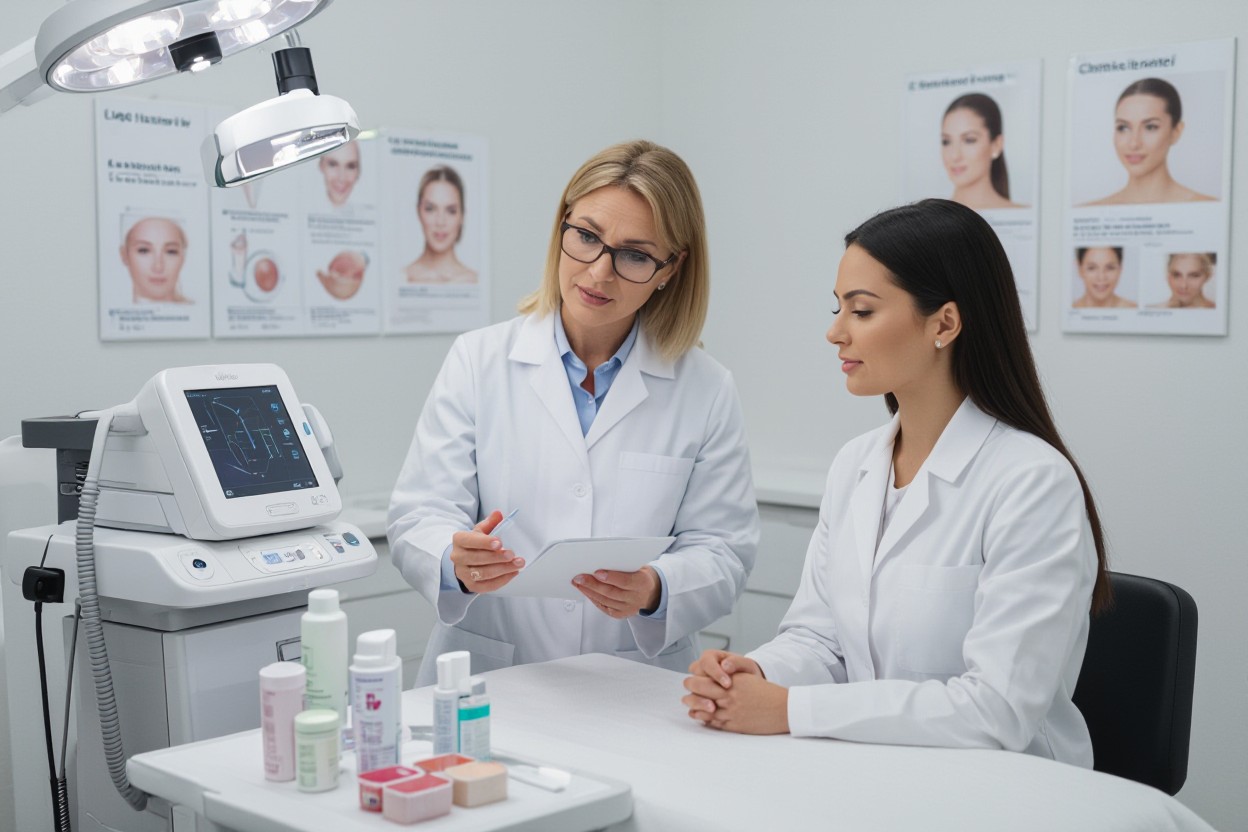
Personalization is Key: Consultation Strategies for Optimal Results
Assessing Skin Goals and Lifestyle Factors
You and your clinician should list specific targets—smoothing texture, fading hyperpigmentation, or reducing scars—then review sun exposure, current topical drugs, and how much downtime you can accept. Quick checks include:
- laser history and tolerance
- chemical peels response and depth previously used
- skin type (Fitzpatrick I–VI)
- lifestyle (outdoor work, smoking, travel)
The consultation should document isotretinoin use, allergies, and prior PIH to reduce risk of post‑inflammatory hyperpigmentation.
Crafting a Customized Treatment Plan for Clients
You and your provider should build a plan with sequencing, e.g., a preconditioning phase (topicals like retinoids 2–3 weeks), a test patch, then 3–6 chemical peels or 3–5 laser sessions spaced 4–8 weeks apart, adjusting energy for higher Fitzpatrick types and defining clear aftercare to limit complications and downtime.
One practical example: a 40‑year‑old with Fitzpatrick III and mixed sun damage often does well with three 30% glycolic peels every 4 weeks (noticeable 40–60% improvement in pigment/texture by month 3), whereas moderate acne scarring might need fractional CO2—typically 3 sessions at 8‑ to 12‑week intervals (energy/density titrated per test patch). You should expect documented consent, photos, and follow‑up at 1 and 6 weeks; post‑inflammatory hyperpigmentation and infection are the main risks to monitor, so conservative settings and strict sun protection matter. For reference only, see https://www.advanceddermatologypc.com/blog/which-is-better-chemical-peel-or-laser-resurfacing/; Skin Care Pro Group does not endorse any third party opinions.
Conclusion
So when choosing between laser and chemical peels, you should weigh your skin type, downtime tolerance, and treatment goals; lasers often offer targeted precision and longer-lasting results while peels can be more affordable with less recovery. Consult a board-certified dermatologist to determine the best option for your concerns. For reference only: see this article — Skin Care Pro Group does not endorse any third-party opinions.